Seeing What 70 Years Of Exploration Couldn’t
The full historic record for the Wedge and our other projects, reprocessed
UAV drone surveys at a resolution the original explorers could not reach
TDEM at surface, BHEM down the hole, making metal bodies glow hundreds of meters down
EarthEx modelling produced seven ranked Maxwell Plate targets. Apex Geoscience is now building the deposit model from all survey and drill data
every hole tests a modelled target, and each result sharpens the next
Daniel Card, P.Geo., RPGeo — founder, President and Chief Geophysicist; formerly Abitibi Geophysics and Southern Geoscience. The system read one third of the trend and produced seven ranked, drill-ready targets at 300–450m. Full pipeline in-house: UAV acquisition, TDEM/BHEM, 3D modelling and Maxwell Plate targeting — the same physics that found Brunswick No. 6 in 1952, at resolution the original explorers couldn’t imagine.
Mike Dufresne, M.Sc., P.Geo., President and co-founder, working directly with Nine Mile. Discovery teams: George–Goose Lake (4+ Moz), Three Bluffs (760 koz), Perseverance. VMS résumé includes the Chester Deposit in this camp. Full team on the ground across all four projects.
What is VMS?: Volcanogenic Massive Sulphide (VMS) Deposits
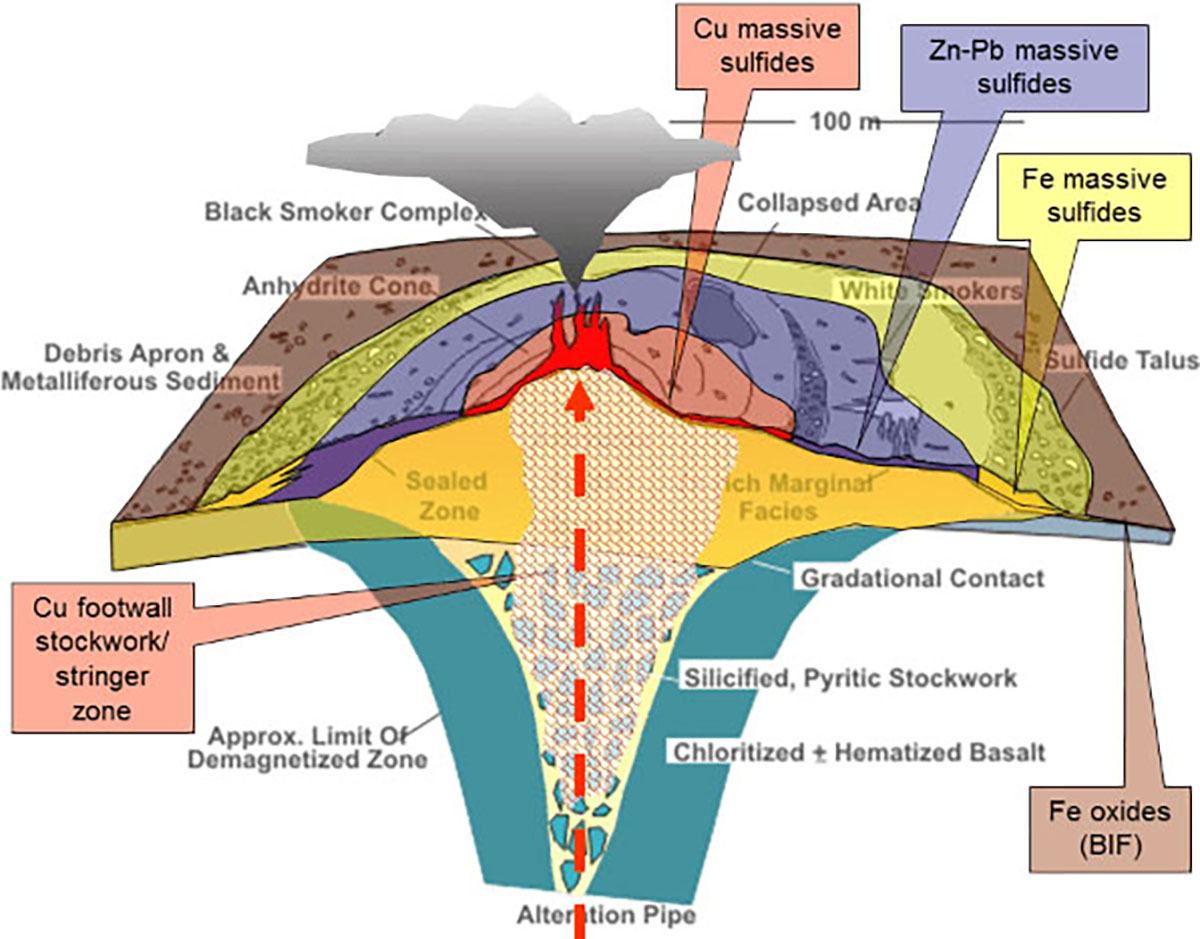
A volcanogenic massive sulphide (“VMS”) deposit in its simplest form is a series of massive to semi-massive sulphide (Cu, Pb, Zn, +/- Au, Ag) lenses typically formed on or below the sea floor resulting from the circulation of metal-bearing fluids driven by a magmatic heat source. A simplified block model comprises a debris field of collapsed sulphide chimneys (Black Smokers) over an alteration pipe which was the metal bearing fluid pathway. Classic examples have high temperature copper bearing minerals in the vent complex (stockwork / stringer zone) with lower temperature lead and zinc minerals being deposited along the flanks. In the BMC, there is also a large Fe component represented by both pyrite and more local Fe formations, the latter key to some of the discoveries.
The Green Revolution is bringing an increased demand for Cu, Pb, Zn, and Ag, in an already global shortage of these metals. The need for Copper wiring and battery metals is 40% of every electric car, and charging stations coming first to mind. Demand for both Lead (Pb) and Zinc (Zn) is exploding as battery development matures. Copper and silver are also key components of solar panels and wind turbines, due to their high conductivity. We all want to have an environmental friendly footprint and a reduction in fossil fuel usage, however the dilemma that faces us is that, with several countries stipulating new car sales to be 50% EV by 2030 & 100% by 2050, at the present time there is not enough supply of the required base metals to support that goal or even get close.
The opportunity for VMS exploration is very optimistic
With high-grade lead, zinc, copper, silver and gold in one single deposit, and with long mine life, VMS is very appealing to production mining companies.
Nine Mile Metals is very well positioned and actively pursuing the source deposit to our discovered VMS lens.
Born in 1952 with the discovery of the Brunswick 6 mine, the 1950’s were productive with 29 deposits discovered by leveraging the newest technologies available including airborne surveys and ground geophysical methods. As technology and analytical advancements were made, discoveries increased in the 1970’s and 1980’s with the application of low cost analytical and geophysical techniques. Regional studies from the mid 1990’s to 2000 included the camp wide EXTECH- II Project, which integrated multidiscipline data, including magnetics (Aerodat) and electro-magnetics (MegaTEM) into a GIS format leading to the discoveries of the Camelback, Mt. Fronsac North and Key Anacon East (Titan). From 2020 onward, advancements in data processing and particularly the analysis of geophysical data, including the Extech and Aerodat programs, is leading to the identification of high quality, priority targets not previously recognized in the legacy data.
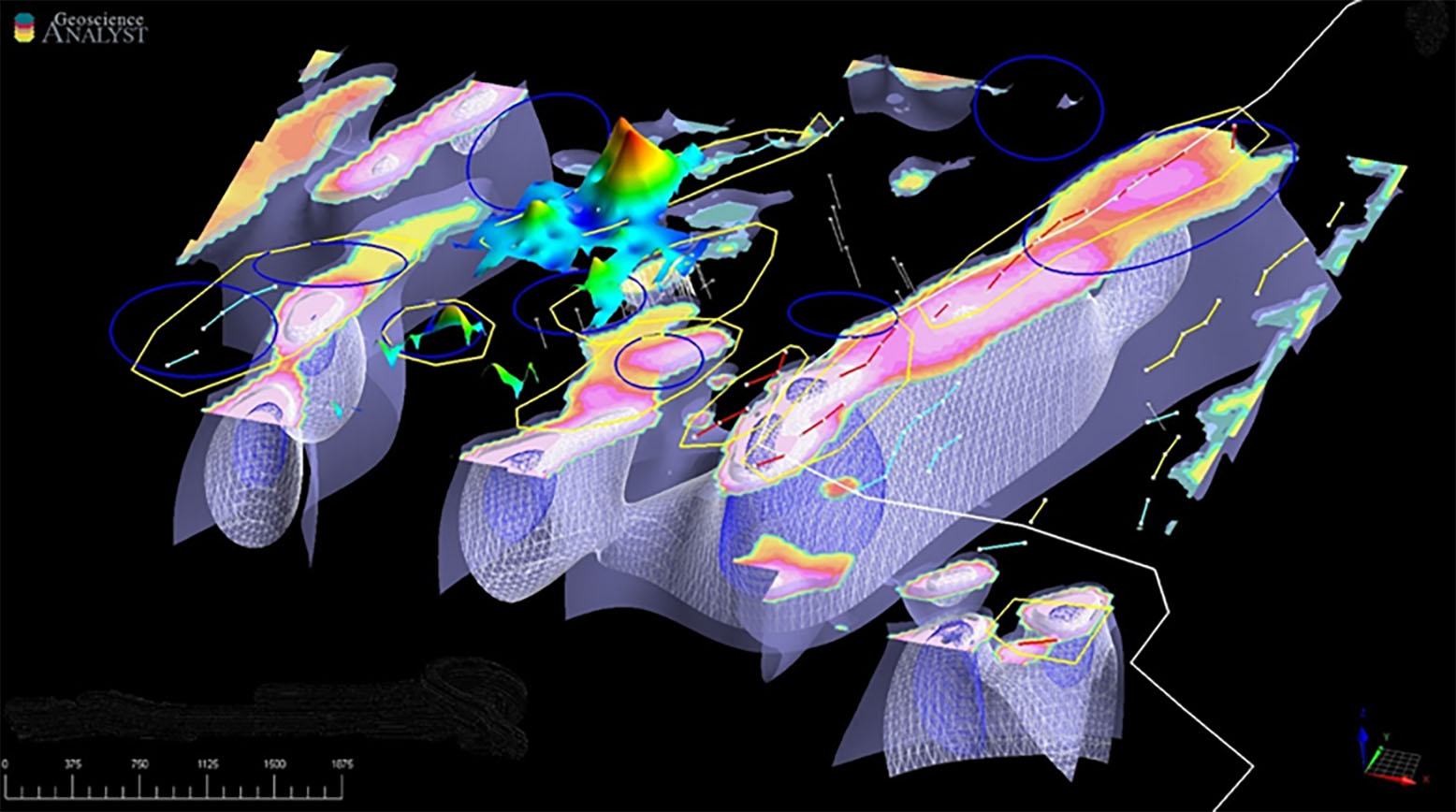
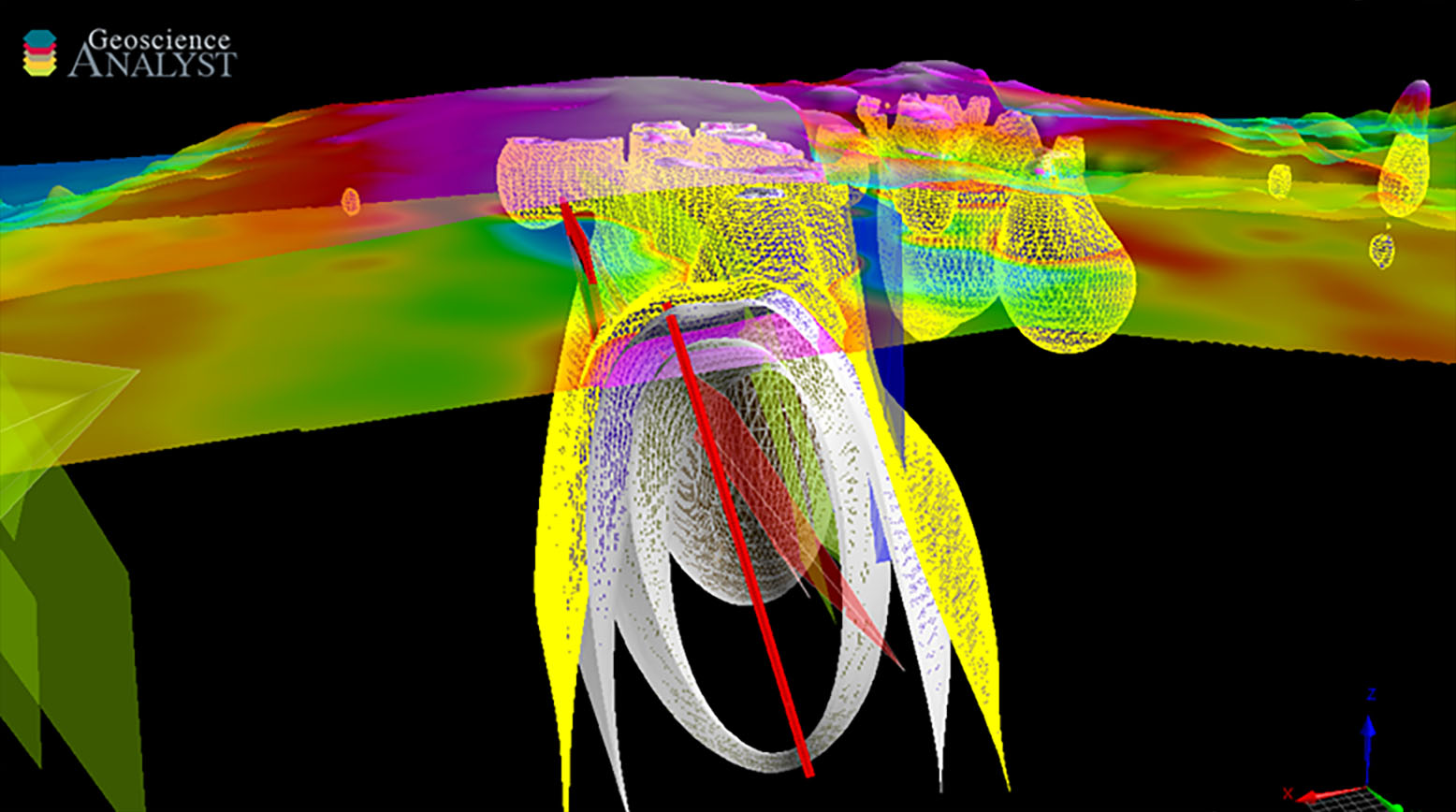
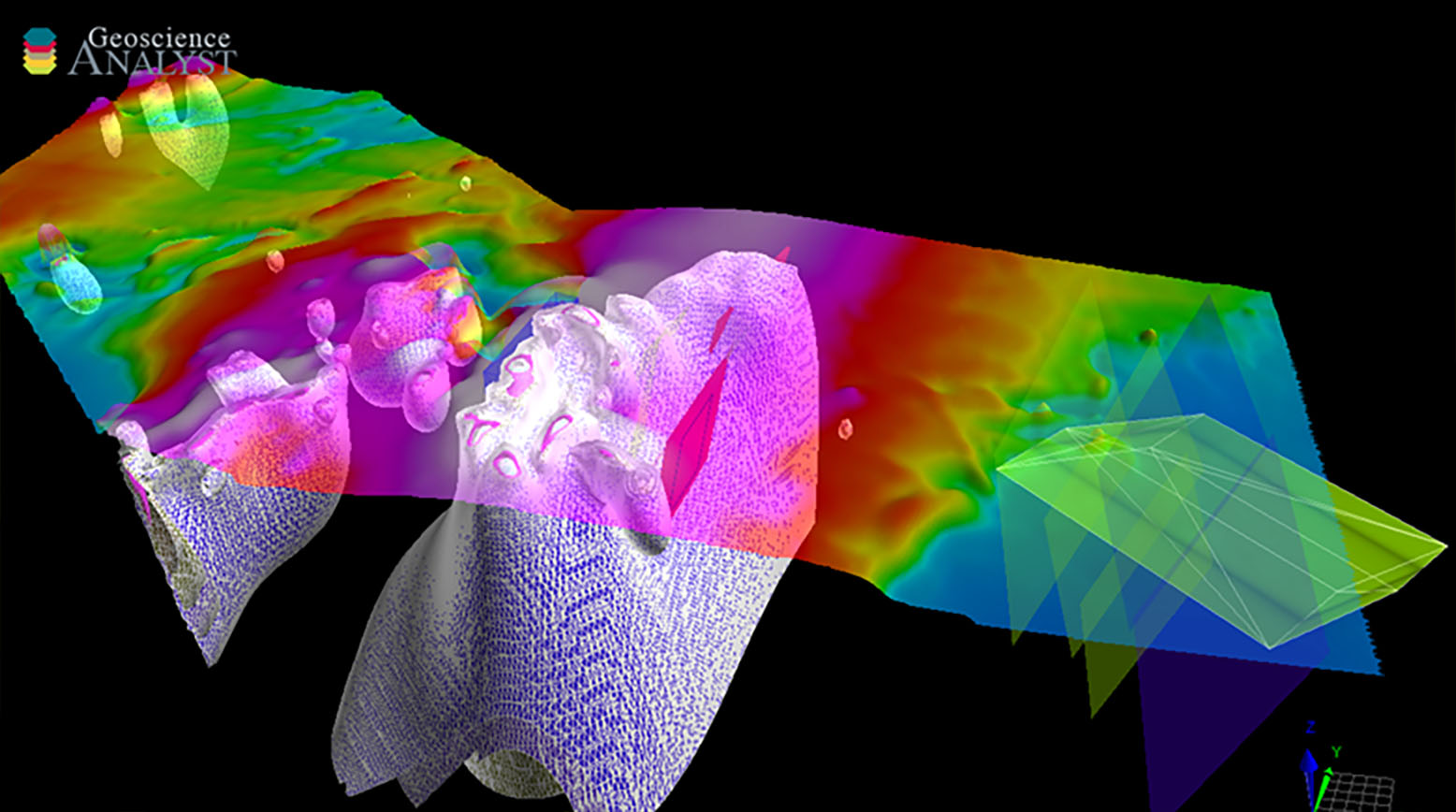
Examples demonstrating the power of this new technology, taken from other project areas in the Bathurst Mining Camp, are shown below.
The next wave of discoveries will be led by AI technologies and 3D modelling of data.
WD-26-09 and WD-26-10 intervals are reported as true widths. All other widths are drilled core lengths and true widths are not yet known. Certified assay results and visual estimates from core logging are identified separately wherever they appear. Assays for the remaining Phase 3 holes are pending at ALS Global.
Copper equivalent values are for comparison only and are not directly comparable between holes; each is calculated on the metal prices and recovery assumptions disclosed in its own news release, which differ by release.
| Hole / Group | Pricing Date | Source | Recovery |
|---|---|---|---|
| 2024 Wedge holes | 13 May 2024 | — | 80% |
| WD-25-02 | 13 February 2026 | — | 80% |
| Nine Mile Brook bulk sample | 27 February 2026 | — | 80% |
| WD-25-2B | 1 April 2026 | — | 80% |
| WD-26-09 | 11 August 2026 | Bloomberg | 95% |
| WD-26-07 | 15 August 2026 | Bloomberg | 95% |
| WD-26-10 | 26 August 2026 | Kitco | 95% |
Cominco production figures for the Wedge — approximately 1.5 Mt at 2.88% Cu, mined 1962–1968 — are historical, are sourced to McCutcheon et al. (2005), predate National Instrument 43-101, have not been verified by a Qualified Person, and are not current mineral resources or mineral reserves. Historic camp production tonnages and grades are sourced to McCutcheon, S.R. and Walker, J.A. (2020), Geoscience Canada, v.47(3), Table 1, published by the Geological Association of Canada.
No mineral resource or mineral reserve has been estimated on any Nine Mile Metals property to date. A mineral resource estimate for the Wedge is in progress; there is no assurance that it will be completed or that it will support a mineral resource. Geophysical targets shown are conceptual, are derived from modelling, and are not mineral resources.
Samples are analyzed by ALS Global, Moncton, New Brunswick, an accredited laboratory independent of the Company. Base metals by ME-ICP61a four-acid digestion with ICP-AES; gold by fire assay Au-AA23 with AA finish; overlimit gold by gravimetric analysis and overlimit base metals by OG62. ALS runs its own QA/QC protocols including coarse and pulp duplicates. The Company inserts certified reference materials, duplicates and blanks with review of all results; QA/QC and data validation were performed and no material errors were observed.
The scientific and technical information in this presentation has been reviewed and approved by Gary Lohman, B.Sc., P.Geo., VP Exploration and Director, the Company’s Qualified Person under National Instrument 43-101. Mr. Lohman is not independent of the Company. The Qualified Person has verified the data underlying the technical information in this presentation, including sampling, analytical and test data.
References to the Bathurst Mining Camp as the third largest VMS camp in the world are based on published district tonnage comparisons, which rank the camp third at approximately 250 Mt. Source: Barrie, C.T. and Hannington, M.D., Classification of Volcanic-Associated Massive Sulfide Deposits Based on Host-Rock Composition, Reviews in Economic Geology. That comparison excludes districts in China and the former Soviet Union.

Get notified about the latest company news and updates by signing up below.